
The decision between a private lender vs bank for real estate investment has shifted dramatically since 2023 — and experienced operators are no longer treating it as a close call. Three years ago, a broker or operator could make a reasonable case for routing certain investment deals through a regional bank. The terms might be cheaper, and for low-urgency transactions, the timeline was tolerable.
That calculus has shifted. Since the regional bank instability of 2023, commercial real estate and residential investment lending at the bank level has contracted in ways that have fundamentally changed how deals get done. Understanding why experienced operators and accredited investors are choosing private capital — and what to look for when selecting a private lending partner — is now essential knowledge for anyone active in real estate investment.
What Has Changed in Bank Lending Since 2023
Federal Reserve survey data and FDIC quarterly reporting have both documented a sustained tightening of commercial real estate loan standards at regional and community banks following the instability of 2023. The result has been a meaningful contraction in bank appetite for transitional, value-add, and investment property lending.
Practically, this means longer approval timelines, higher documentation thresholds, tighter debt service coverage requirements, and reduced flexibility on loan structure. For deals that move on competitive timelines — which is most deals in active markets — the bank approval process has become a liability rather than an asset. Commercial bridge loan originations were up 14% year-over-year in early 2026, and private financing now accounts for nearly 40% of non-owner-occupied purchase volume in major metropolitan markets.
Where Private Lenders Structurally Outperform Banks
The comparison between private lenders and banks is not simply about speed, though speed is a major factor. The deeper distinction is structural.
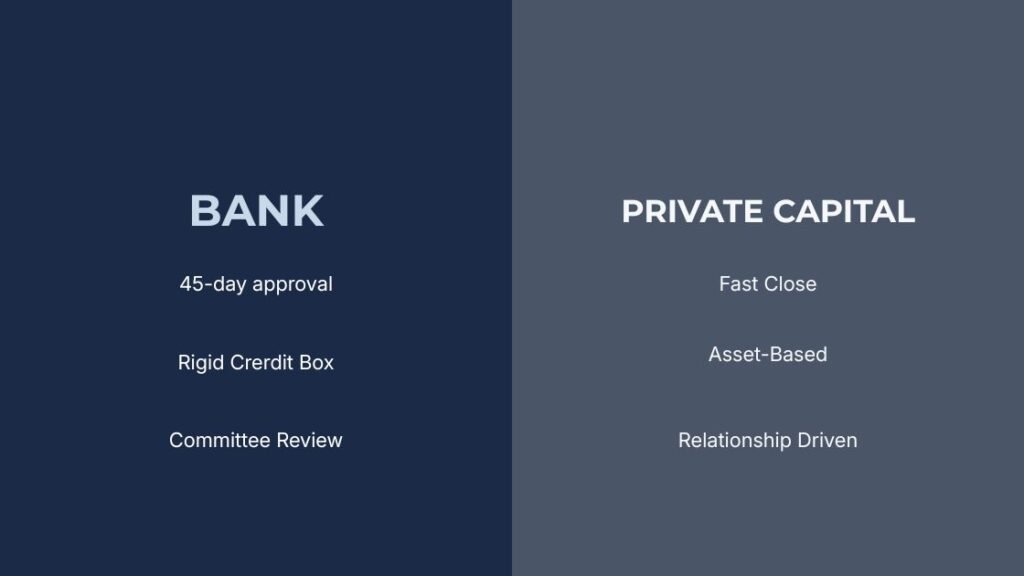
Underwriting focus. Banks underwrite the borrower’s financial profile — income, tax returns, debt-to-income ratios. Private lenders underwrite the asset and the deal. The property’s value, the exit strategy, and the borrower’s execution track record drive the decision. For experienced operators with complex deal structures, this distinction is significant.
Timeline. Traditional bank underwriting for investment property often runs 45 to 60 days or more. Private lenders operating with experienced in-house teams can move from submission to term sheet in days and close in under two weeks on prepared deals. In competitive bid situations, that difference is often the deal itself.
Flexibility on structure. Banks operate within rigid credit boxes. Private lenders can structure deals around the specific needs of the transaction — interest-only periods, flexible draw schedules for renovation financing, and terms calibrated to the actual business plan rather than a standardized product.
What Accredited Investors Look for in a Private Lending Fund
For accredited investors evaluating private real estate credit as an asset class, the bank pullback creates a compelling backdrop. Demand for private capital is structurally supported, deal flow is strong, and asset-backed lending provides collateral security that other credit strategies do not.
What separates a disciplined private lending fund from an undercapitalized one is underwriting consistency. A fund that applies rigorous, repeatable criteria across market cycles — not just when conditions are favorable — is one that can deliver consistent outcomes for investors. At Anchored Real Estate Capital, our team’s combined background in asset management, commercial underwriting, and capital markets shapes every credit decision we make.
What to Look for in a Private Lending Partner
Not all private lenders are equal. The growth of the private lending market has brought both sophisticated capital sources and undercapitalized operators into the space. When evaluating a private lending partner — whether as a borrower, broker, or investor — the questions that matter most are: Does the lender have genuine expertise in your deal type? Do they issue terms they can stand behind? And do they communicate clearly when a deal is in motion?
At Anchored Real Estate Capital, we are a private real estate lending fund — not a broker, not a marketplace, not a retail platform. When a deal comes to us, it is evaluated by experienced principals who understand what the transaction needs to close. When capital is committed, it is committed.
Connect with Anchored Real Estate Capital
Whether you are an operator with a bridge deal, a broker building your private lender roster, or an accredited investor exploring private real estate credit, we want to hear from you. Our team is actively deploying capital and building long-term partnerships across all three groups.
Ready to submit a deal? Email our team at info@anchoredre.com with your property type, location, loan amount, and exit strategy. Or submit directly at anchoredre.com. We respond within one business day.